

















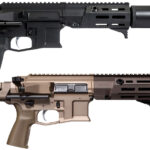
VLTOR/POF USA 6.5 Grendel
Classic AR is redefined in a conversion delivering accuracy up to 1000 yards!

Several manufacturers have introduced AR-type carbines in 6.8 Special Purpose Cartridge (SPC), properly designated 6.8×43mm and the 6.5 Grendel (6.5×38mm) in an effort to upgrade the terminal ballistics of the carbine that has become the mainstay of the US military, but whose performance in the sandbox has been less that satisfactory in terms of terminal ballistics. Upgrading from a 5.56×45mm carbine to either of the larger-diameter cartridges is as easy as changing upper receivers and magazines. There are proponents for both cartridges and there have been many efforts to directly compare them.
A direct comparison of the two cartridges may not exactly be an “apples and oranges” analogy, and such comparisons are more akin to comparing peaches and apricots. While similar in some ways, the cartridges are different and were designed for quite different purposes. The 6.8 SPC was designed as a close-quarters battle (CQB) to 400-meter cartridge that would deliver increased lethality compared to any existing 5.56×45mm (.223) cartridge.
During the development process that led to the 6.8, cartridges in 6.5mm, 7mm and 7.62mm were tested, all using .30 Remington cases. The current 5.56×45mm and 7.62×39mm cartridges served as baselines for comparisons. Other goals included increased range and energy, better cover destruction, better efficiency and increased bore life.
The 6.5 Grendel, on the other hand, was intended as a long-range cartridge that could be fired from an AR-type rifle. The fact that the 6.5 Grendel became a “de facto” competitor against the 6.8mm SPC came from misunderstanding the different purposes of the two cartridges and the fact that commercial deliveries of 6.8 ammunition were sporadic until recently. This, coupled with the 6.5’s superior long-range ballistics, has caused some to consider the 6.5 Grendel as a potential candidate to supplant if not replace the 6.8 SPC. Regardless, in an in-depth comparison in Infantry Magazine, it was noted that in terms of long-distance shooting, the 6.5 Grendel overshadows the 6.8 SPC. Even at closer ranges, the 6.5 has superior ballistics.
The 6.5 Grendel is more resistant to crosswinds due to its higher sectional density and superior ballistic coefficient. This is not to disparage the 6.8 SPC but to emphasize that it was designed as an intermediate range cartridge while the 6.5 was designed as a long-range cartridge.
One fact is incontrovertible, beyond 500 meters, the 6.5 Grendel completely overshadows the 6.8 SPC. We have seen reports of sub-half minute-of-angle groups fired from 6.5 Grendel rifles at 600 meters, but since our range does not extend to that distance, we were unable to confirm this claim. We did find, however, that the 6.5 we tested was extremely accurate at 100 yards. That said, we’ll leave the 6.5 versus 6.8 discussion and focus our attention on the subject at hand, that is Vltor’s 6.5 Grendel carbine conversion.
Conversion Details
Like the 6.8, the 6.5 can be assembled on any Mil-Spec AR lower receiver by simply dropping on a 6.5 upper receiver. In fact, this is how we obtained a test rifle. Vltor sent us an upper receiver and a couple of magazines. We had a few boxes of Alexander Arms 6.5 ammunition on hand and got some of Black Hills 6.5 to complete the test. Besides ammo from wolf these are the only sources for 6.5 Grendel we are aware of. We provided the lower receiver.
Because the 6.5 Grendel cartridge has a slightly different profile than the 5.56×45mm cartridge, the 6.5’s magazine feed lips and follower require a slight modification as is the case with the 6.8.
The Vltor VIS (Versatile Interface Structure) upper we received was manufactured and equipped with several items from Vltor.
VIS uppers are available in several lengths, but aren’t currently available from Vltor as complete barreled upper receivers. The VIS user will need to provide their own barrel, bolt, bolt carrier and charging handle for the moment. VIS upper receivers use standard AR barrels and all components necessary for fitting the barrel are included.
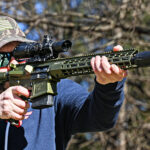
The basic VIS provides an uninterrupted MIL-STD-1913 rail from the rear of the receiver all the way to the gas block, two MIL-STD-1913 rails on the sides and a fourth on the removable bottom half of the handguard. The removable bottom half facilitates installation of an M203 grenade launcher and helps with cleaning. In addition, the VIS free floats the barrel. There are four lengths of VIS to accommodate just about any barrel length: VIS-1 Carbine (7 inches), VIS-2 Midlength (9 inches), VIS2A Extended Midlength (10 inches) and standard rifle (12 inches). Our sample VIS was the standard midlength but with a few extras.
A major innovation is Vltor’s tactical bipod that mounts on top of the handguard rather than the bottom like conventional bipods. What’s the big deal about Vltor’s top mounted bipod? Mounting the bipod on top lowers the center of gravity of the rifle by approximately 2 inches, making it much more stable and less prone to being knocked over when someone accidentally bumps against it with their foot. Don’t laugh, I’ve seen this happen many times when rifles are sitting on their bipods. Vltor’s bipod doesn’t absolutely prevent the rifle from being knocked over, but it significantly reduces the chances of that happening.
Another feature is Vltor’s proprietary muzzle brake that significantly reduces flash. Finally, the VIS conversion came with Vltor’s fully adjustable back-up iron sights (BUIS) that lock firmly into place when up and rise easily with the touch of a finger.
I used a match grade P415 lower from Patriot Ordnance Factory (POF-USA) for the bottom end. Because of its high quality and the fact that the POF USA lower came from the factory set up the way I like it with Vltor’s Modstock and single stage match trigger, I mounted the 6.5 Grendel on the POF USA lower. Vltor also offers Modstocks for full-size ARs and even for M14/M1A-type rifles and AKs.
Modstocks provide waterproof storage for small items and batteries for electroptics that are so prevalent in today’s tactical shooting milieu. Modstocks also provide a broad flat cheekrest that’s so far superior to the rounded stock on standard M4 type carbines that I can only wonder why most manufacturers do not offer Modstocks as an option or even as standard like POF.
The stock is comfortable and places the shooter’s eye in an ideal position for either open sights or optics. I like Modstocks so much that I fit any test rifle or carbine that comes our way with one, whether adjustable or full length. A Modstock makes a significant improvement in the “feel” of any rifle or carbine on which it is fitted.
Leupold Mark 4 1.5-5×20mm
Modern optics are very rugged, much faster on target and are more accurate than open iron sights. Iron sights require that the shooter focus on three separate elements: rear, front and target. Aligning the front and rear sights is critical if the shot is to be accurately placed and a small misalignment of the sights causes gross errors in aim. With an optic, there is no sight alignment necessary. All the shooter needs to do is place the reticle on the target and shoot it.
For our 6.5 evaluation, we chose Leupold’s Mark 4 1.5-5×20mm MR/T riflescope recticles. Once zeroed, the scope has “hash marks” that delineate distance in mils, enabling the user to engage targets from CQB out to the scope’s effective range without dialing in clicks. Adjustments are in 0.5 MOA increments and the reticle is in the second focal plane, which basically means that it stays the same relative size regardless of magnification. The reticle is illuminated in red so as to not interfere with the shooter’s night sight, but with state of the art night vision like that described below, illuminated reticles aren’t necessary.
OSTI AN/PVS-22 UNS
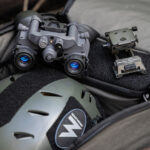
The best image intensification (I²) technology is represented by Optical Systems Technology’s AN/PVS-22 Universal Night Sight (UNS). The generation III+ PVS-22 mounts ahead of the day optic. The need for an IR reticle is also eliminated. Because it mounts ahead of the day optic, the PVS-22 can be used with the day optic’s reticle. The PVS-22 delivers crystal clear images with zero “hot spots” due to its adjustable gain.
We are seeing more and more carbines and rifles like the test Vltor equipped with MIL-STD-1913 rails that extend ahead of the day optic to accommodate the PVS-22, which delivers night vision capability that surpasses that of the PVS-17, yet is significantly smaller, far more versatile and user friendly. Sales of OSTI NVS are restricted to law enforcement and military and require State Department approval for export outside the US.
SureFire M900
I also installed a Surefire M900 Vertical Foregrip WeaponLight with an optional infrared (IR) filter. This versatile foregrip/high intensity light has ambidextrous momentary activation pads for the main battle light, a constant on switch and a momentary push switch for the two integral low output LEDs that are used for stealth navigation. This light emits 125 lumens of high intensity focused light for an hour and attaches to the bottom MIL-STD-1913 rail via an ARMS throw lever.
While the OSTI PVS-22 is great in night vision technology, it requires some light and so in ineffective in total darkness. For situations like this, the SureFire IR filter is rotated into place over the lamp lens, enabling the carbine user to clear using IR light that is invisible to the human eye. Of course, IR can be detected by other night vision optics, but the IR Surefire coupled with the PVS-22 is about as good as it gets.
Range Time
If there is any limitation to the 6.5 Grendel, it is that presently there are only three manufactures for it, Black Hills 123-grain Sierra MatchKing, Wolf and Alexander Arms 123-grain Lapua Scenar hollow point boattail (HPBT) match bullet. The Alexander Arms 123-grain remains supersonic beyond 1000 yards due to its very high ballistic coefficient (BC) of 0.547. Other loads are in development and should soon be available. These include a 90-grain Speer TNT (BC 0.281), 120-grain Nosler (BC 0.458) and 129-grain Hornady SST (BC 0.485). The testing proved that the 123-grain loads were indeed very accurate.
The test rifle had an 18.5-inch barrel (20 inches with the muzzle brake) and put every round essentially into a 0.5 minute-of-angle (MOA) group. I had one called flyer in the best group of the day and it was only 0.75 inches outside the main 0.5-inch group. In fact, the first three of five shots were touching and if I consider only those first three as many shooters do, the group shrinks to about 0.25 inches! Not bad for a gas gun!
Shooting was otherwise uneventful. The two-stage POF match trigger broke at 3.5 pounds. There was not a single stoppage during the entire day’s shooting. Felt recoil was about the same as a .223, although I didn’t do a side-by-side comparison. Brass was positively ejected almost straight out the ejection port, landing about four feet from the rifle.
Final Notes
The 6.5 Grendel brings a new capability to the AR for anyone who owns such a rifle. First, it is a cartridge that delivers true long-range performance to 1,000 yards and beyond. Since the 123-grain bullet remains supersonic to approximately 1,200 yards, accuracy should not suffer, as the transition from supersonic to subsonic velocity is a major factor in loss of accuracy because the bullet tends to become less stable as it transitions back through the sonic barrier. For the military user, this is good news.
For law enforcement, the 6.5 provides an extremely accurate rifle that not only is far more lethal than any .223 but enables quick follow-up shots. It is thus ideal for use as a perimeter rifle, CQB carbine in shorter barrel lengths, or with 20- or 24-inch barrels, for duty with precision tactical marksmen.
The cartridge and rifle combination offered by Vltor is a superb package that delivers the goods.


August 16th, 2009 at 1:49 pm
M-14 with a lightweight synthetic stock could reduce weight to a point where recoil and controlability are more severe, and comprimised.
My military days are long over, and I never was in a combat unit. As an Air Force medical officer I was only required to qualify with the M 92, I think, Beretta 9mm( I date to days when it was S&W 38 revolver). I did comment to some of the less gun savey enlisted personnel that if we ever needed to be issued fireams, I would gladly trade my 9mm for a M-16.
I have been shooting a 6.5 Grendel lately, the cartridge intrigues me. For a bit of give for weight in the ammo category it seems that you get a lot in performance over the 5.56.
I like big battle rifles but generally speaking I think the sun has set on their day, and the lighter weight, handier, modular personal weapon is here to stay. If I were in combat in a non urban setting, and having to use iron sights, I would prefer the standard M-16 configuration. Close combat in an urban situation the M-4 carbine wins hands down. I would like the cartridge the throws a bigger bullet. For one shot kills or incapacitions nothing will probably ever surpass the 54, 58, and 69 cal Minie ball muzzleloaders of our civil war.
August 15th, 2009 at 5:32 am
6.5 is the best round period. If you could only have or if I could only have one rifle. Im choosing 1200 yds at super sonic, .05 moa and slightly more kick than a .223? Oh yeah its light. What currently out there thats better? Nothing thats what. The Englishman’s on to something good and should be praised also this round should be the next one for our troops. Combining this round with Dragon Skin would save many lives.
July 19th, 2009 at 11:19 pm
Instead of everyone displaying a condescending attitude why don’t we try and learn something from each other. I think it makes sense that someone who has either served on a Police force, Military or special ops. where their life is on the line and been in the line of fire would have a better understanding of weapons and the reasons for using a certain one in a given situation, I think that only makes sense. I admit I don’t have a lot of experience with guns and no doubt can learn from all of you. However, it bothers me when we don’t show mutual respect for each other, especially the men who have put their lives on the line for our freedom. Goodnight.
Carey
June 28th, 2009 at 5:30 am
The 6.5 is not a stupid idea. Its evolution. Yes, we moved away from the m-14 for its weight, recoil and ammo weight. The 5.56 is now the standard carry cartridge and there are complaints about its lethality. Tell these people to carry an m-14 with kit and ammo on top of the 80+ lbs of gear and it becomes a suckfest real quick. The 6.5 is a good balance between the two. It actually has BETTER ballistics than the m80 7.62 ball beyond 400 yards. You can still use the same lower as any m16/m4. Hows that for saving money. The 6.5 is an incredibly accurate cartridge as well.
May 13th, 2009 at 9:51 am
[...] speaking of Charlie Cutshaw articles, we might as well mention Mr. Cutshaw’s cover gun article on the Vltor/POF 6.5 Grendel (a.k.a. 6.5mm Grendel) semi-auto direct-gas-impingement (DGI) AR-15 [...]
May 9th, 2009 at 12:36 pm
have you ever tried to clear a room with a M-14? Obviously not! Don’t get me wrong…great rifle for longer ranges but a pain in the butt in CQ. And you’ve obviously never toted a full load of ammo all day in the blistering heat with full plated vests. very reliable and effective at long ranges but way too heavy, too long, and too much felt recoil in a close quarters engagement. Hard to recover and aquire same target or related targets shots. It has it’s purpose but not an all around/ fits all weapon system. looking forward to some 1 on 1 with the 6.5
May 1st, 2009 at 6:42 am
All you subject matter experts make me laugh. The US army steered away from the 7.62 because of ammo weight. If you have ever walked a sector with the new body armor then weight is an issue. So lets rule out the reliable M14. No matter how many mods you put on that weapon to modernize it. The grendel is what i would choose. WHY ?? Be cause of my current tour which is my third in this area of the world. I am a security commander for convoys. 5.56 nor will the 6.8 punch a target at the ranges given to you by insurgents. from 10 meters to a full grid. You need to identify, access, verify, then terminate in the span of seconds. So do your research. Terminal ballistics favor the 6.5 for numerous reasons. Til your on the ground in the heat “of it” you really have no room to talk. A thousand yards fixed position. The nod goes to the M14. Mobility gives the nod to the 6.5
April 16th, 2009 at 10:04 pm
Anyone know the make of the bipod on this gun?
April 5th, 2009 at 9:57 pm
my bad guys left some out i meant to write until you are trained in a mout enviroment where you clearing towns and villages if not citys, building by building you wouldn’t understand.
April 5th, 2009 at 9:53 pm
Because the m14 has to much knock down power and why erase the last 40 50 years of research and devlopement of weapons. the m14 is a good rifle but the grendal is not complicated at all. You don’t want a 30-06 or close to that for a close quarters it doesn’t make any sence and until you are trained by the military or police you wouldn’t understand. Unless you took the time to actualy research combat and what it has evolved into.
Lcpl
Nichols, John usmc
Baharia Iraq
April 2nd, 2009 at 2:35 pm
Amen to what Greg says! I am serving in th Air Force and haven’t been close to combat, but I would love using an M14.
April 2nd, 2009 at 12:10 pm
Amen to what Rick says.
March 22nd, 2009 at 1:05 am
This 6.8 SPC and 6.5 Grendel AR stuff is stupid and too complicated. If the military wants better knockdown power (6.8 SPC) and greater range (6.5 Grendel), why doesnt the military just keep it simple? And go back to issuing M-14’s? Maybe get rid of the heavy Walnut stocks and go with a lighter synthetic stock or a adjusting synthetic stock, with a pistol grip? But otherwise, keep the M-14 the same.
To me, this seems cheaper, simpler and probably better than either 6.8 SPC or 6.5 Grendel. There were so many complaints in the sixties when the Army and Marines went from the M-14 to the AR-15 and now, forty years later, look whats happening? The military is deciding it wants longer range and old school knockdown power.
Just go back the M-14…